Sports Weekly all-media reporter Wang Qinbo
Perhaps one of the most serious misunderstandings about Chinese football in recent years is not that it is backward in technology or physical condition, but that the understanding of the concept of "advanced football" has been deviated from the very beginning.
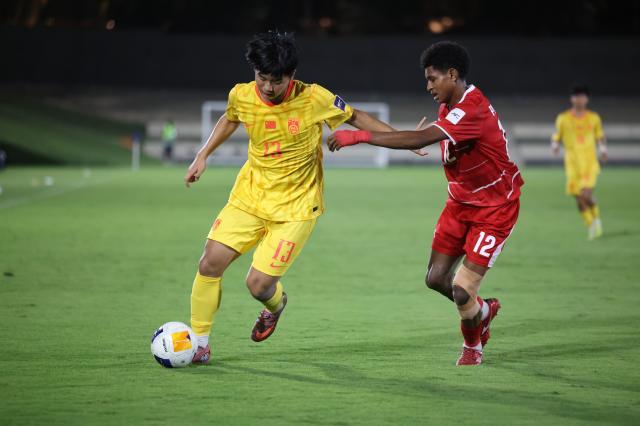
After recently watching U15 and U17 level games one after another, one feeling has become stronger and more obvious: China’s youth training is being led down a biased and misguided path by the word “pass and control”. Moreover, such a deviation in direction has begun to show a systematic trend to cause harm to young players.
The problem first lies in translation.
In the past ten years, Chinese football public opinion has continued to repeat the saying "Spain passes and controls football", as if passing the ball more often and switching from the backcourt more frequently are already close to the core of the so-called modern football.
But the real foundation of Spanish football is not simply "possession", but "Positional Football" (Juego de Posición), which originated in the Netherlands and was transformed by Catalonia, especially Barcelona, to show off its skills. This is its true foundation.
The Internet is full of Spanish football textbooks, teachings and cases in related positions. This word is particularly easy to be confused with another word. Specifically, it refers to the word Juego de Posesión, which means "possession". The difference between them is only one element, but in fact they are completely different in nature, that is, completely different concepts.
The core element of positional football is by no means a simple model of "possessing the ball for the sake of possession". Instead, it relies on the relationship between positions, the occupation of space, and dynamic conversion methods to achieve numerical advantages in local areas and differences in attack time. Possession of the ball is only a performance situation presented by strong teams under the concept of positional football. It is only a superficial phenomenon and is not the ultimate purpose of the concept.
Therefore, if you actually watch youth competitions at various levels in Spain, or even watch the performances of Real Madrid and Barcelona at different levels, you will find a reality that is completely different from what Chinese football imagines: many long-distance passes, rapid transfers, and direct forward movements are not uncommon. Sometimes there will be several big kicks in succession, and sometimes the goalkeeper will take the kick directly with the goal of finding the striker.

The essence of football has always been competition, not performance. However, it is precisely in China’s Guozihao echelon that we have witnessed the disastrous consequences caused by an almost rigid “pseudo transmission and control”.
Faced with the opponent's press, the U15 national youth insisted on the so-called "backcourt construction" and finally moved the ball from one side to the other. However, the player holding the ball stopped and waited for the opponent's second round of press; otherwise, when the opponent did not implement high pressure at all, the U17 five or six players slowly fell down in the backcourt to "build", as if as long as the ball did not leave their feet, they were already close to advanced football.
This is not positional football, and it is not modern football.
What's even more ridiculous is that without specific support and protection, the full-back mechanically followed the concept of "playing the ball with his feet" and tried to make an uncertain attempt to escape with the ball. As a result, the ball was intercepted directly, resulting in a key loss. Is this considered advanced football or football lacking in brains.
Even if we are discussing on the basis of mistranslation, the premise of the birth of "backcourt construction" in "pass and control" is that the opponent implements high pressure. The purpose of the opponent's forward pressing is to prevent you from organizing the attack normally, and thus be forced to play the ball hastily. Therefore, you have to use passing, dribbling and coordinated running to get rid of the opponent's first and second layer of pressing. Once you successfully break through, you can directly face the opponent's midfield and backfield that have not yet completed their defense, thus gaining space and time to attack. In other words, make the opponent pay the price for pressing high.
In other words, backcourt construction is a self-protection mechanism and offensive organization method, and its real core is "conversion", which allows the opponent to change from being proactive in high-position pressing to being passive in hastily deploying defenses, so that we can change from being passive and being pressed to being proactive as an attacker.
Today's European football pays more and more attention to the speed of offensive and defensive transitions. Many teams even set up timers on the sidelines of the training ground, stipulating that after regaining the ball, players must advance to the dangerous area within a limited time. This is because only this training method can cultivate players' high-speed decision-making ability, continuous retracement ability, and technical and tactical execution in strong confrontation situations.
In comparison, there are a lot of situations called "backcourt construction" in Chinese youth football. In fact, they are just self-consuming behaviors in a low-intensity environment.
Especially in domestic competitions of the same age group, there are some strong teams that are in a dominant position. In the competitions of these strong teams, there is often a lack of truly high-quality full-court pressing mechanisms. Many players have relative physical and technical advantages, which results in the opponent neither having the ability to press continuously nor building a complete pressing system. Once the press fails to achieve results, they choose to retreat.
Therefore, the "pass and control" and the so-called "backcourt construction" that we are passionate about in daily life have unknowingly evolved into a very slow-paced self-entertainment behavior: whenever others come forward to rob, one simply passes the ball once, and then tries to get rid of it. He thinks that this is particularly handsome, thus creating a false illusion of "playing very modern".
But the question is, can you reach the opponent's restricted area within the valid time? Can it form a real offensive threat?
This is what modern football is really about.
Therefore, once the players trained by Chinese football over the years arrive at the international arena, they immediately show a strange sense of rupture. The center backs are afraid of pressing, the midfielders are afraid of pressing, and the full backs are prone to making mistakes once they move forward with the ball. As for the forwards' first reaction after losing the ball, it is not to counterattack, but to withdraw from the battle.
This is because what they received was not the complete modern football education, but just a "pass and control shell" after a misunderstanding of the situation.
A system that can truly be called an upload control system will inevitably be accompanied by high-intensity counterattacks, an overall pressing situation, and the ability to switch at high speeds. However, why do these forward players not have the habit of counterattacking? It can even be clearly observed that they don't even bother to actively interfere with the opponent's midfielder. Where exactly is the advanced play style that we keep talking about reflected? If the forwards don't even press the opponent's central defender and midfielder, can this still be considered an advanced style of play?
These are all the results of learning "pseudo passing and controlling". We have caused our country's outstanding teenagers to play a kind of "master football" with a slow rhythm, lack of confrontation, lack of transition, and lack of aggression since childhood.
In the past few years, this misunderstanding has been packaged as an "advanced concept" for a long time. Anyone who questions it will be labeled as "not understanding modern football." Therefore, a football concept that was originally based on mistranslation and misunderstanding finally entered the youth training system and even entered the theoretical narrative of "big country football".
Is Spanish so difficult to learn?